
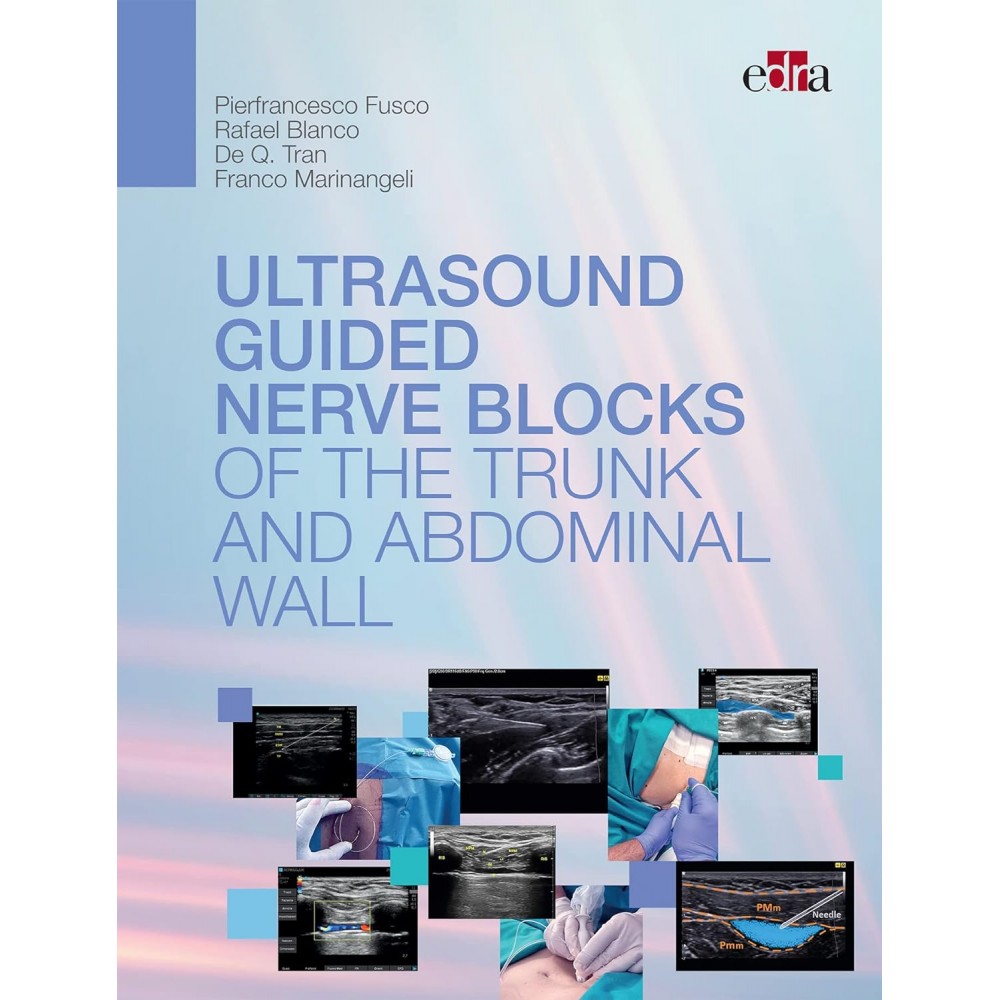


Due to the introduction of ultrasound, the acquisition of new anatomy and sonoanatomy knowledge, as well as recent discoveries on the role of the fascia, regional anesthesia has undergone a process of "evolution-revolution" in the last decade and now is playing a key-role in surgery and postoperative pain management, allowing opioid-sparing or opioid-free strategies, in line with the ERAS pathway.
Due to the introduction of ultrasound, the acquisition of new anatomy and sonoanatomy knowledge, as well as recent discoveries on the role of the fascia, regional anesthesia has undergone a process of "evolution-revolution" in the last decade and now is playing a key-role in surgery and postoperative pain management, allowing opioid-sparing or opioid-free strategies, in line with the ERAS pathway. With the contribution of the most prominent experts in the field, this book is a milestone for all professional figures involved in anesthesiology and pain therapy, thanks to the drawings, tables, flow charts, detailed anatomical and sono-anatomy pictures and clinical cases included in each chapter. The volume includes a chapter dedicated to the anatomy and function of fascia, a section on paraneuraxial block describing the paravertebral block and the ESP block in the countless fields of application, a section dedicated to the anterior thoracic blocks, a section on blocks of the anterior and posterior abdominal wall, a chapter on pediatric wall blocks, several chapters ranging from the neck band blocks, to the application and indication of the LIA and Wound infusion and an innovative chapter on the application of RA techniques in the COVID era. Videos are available on https://USguidedwallblocks.edizioniedra.com
Strengths
Clinical Cases
Videos available on https://USguidedwallblocks.edizioniedra.com
Chapter on the application of RA techniques in the COVID era
Authors
Pierfrancesco Fusco Department of Anesthesia and Intensive Care Unit, San Salvatore Academic Hospital of L'Aquila, L'Aquila, Italy
Rafael Blanco Anaesthesia & Critical Care, King’s College Hospital Dubai, United Arab Emirates
De Q. Tran Department of Anesthesia Montreal St. Mary’s Hospital McGill University, Montreal, Quebec, Canada
Franco Marinangeli Department of Anesthesiology, Pain Treatment and Palliative Care, University of L'Aquila, L'Aquila, Italy
Fiche technique
Références spécifiques
Correct vaccination of dogs and cats requires consideration of a broad range of clinical situations and vaccination options. Using a thoroughly practical approach, this book takes an in-depth look at vaccines and vaccination to provide veterinary professionals with the information they require to address the many doubts and questions that arise in relation to this topic.
Bovine Respiratory Disease (BRD) is probably the most common and costly disease affecting beef cattle industry worldwide. This practical work, written by a highly experienced expert, tries to summarise the most essential features of the disease in an attempt to provide veterinary surgeons with a helpful tool to control this disease properly.
This book is part of the Servet Clinical Guides collection, in which each volume compiles the most relevant material on the subject matter covered. This volume focuses on dermatology and is centered on the management of allergic patients. This new collection was created with the objective of helping veterinary surgeons during consultations and providing them with useful information to establish a good relationship with clients. The goal is to give answers to owners’ most frequently asked questions in order to guide them in the best possible manner, as well as to help veterinary surgeons ensure owners complete the patients’ prescribed treatments and maintain effective clinical monitoring of all processes.
This book deals with pain in companion animals and how it affects their welfare, health and, of course, behaviour. It describes the difficulties encountered, throughout history, to finally reach the conclusion that animals and humans share the same neurophy- siological mechanisms to feel pain, and what their sensitive pathways are. It then goes deeper into the changes that pain can cause in the behaviour of dogs and cats and the tools available to the veterinary surgeon to control it.
Due to the introduction of ultrasound, the acquisition of new anatomy and sonoanatomy knowledge, as well as recent discoveries on the role of the fascia, regional anesthesia has undergone a process of "evolution-revolution" in the last decade and now is playing a key-role in surgery and postoperative pain management, allowing opioid-sparing or opioid-free strategies, in line with the ERAS pathway.


