The Heart. Atlas of...
This atlas shows Cardiology in a way it had never been done before. The images it contains, of both the healthy heart and the main heart diseases that affect dogs and cats, have a unique technical and artistic value.
Active filters
This atlas shows Cardiology in a way it had never been done before. The images it contains, of both the healthy heart and the main heart diseases that affect dogs and cats, have a unique technical and artistic value.
Routine preventative dental care is essential to prevent dental and oral health problems in cats. With more than 400 high-quality images, clear anatomical illustrations, and thorough descriptions, this new volume on veterinary dentistry focused exclusively in cats aims at being a guide for quick visual identification and prompt diagnosis and treatment of oral and dental problems in this domestic species.
Good mouth care is paramount to prevent health problems in dogs. However, some oral conditions may sometimes be really challenging to diagnose and treat. With almost 500 high-quality images, clear anatomical illustrations, and thorough descriptions, this new volume on veterinary dentistry aims at being a quick visual guide for diagnosing oral problems in dogs.
Highly visual guide on how to diagnose alopecia in dogs and cats, in a structured and methodical manner, based on the distribution pattern and lesions. The large number of images, diagrams, tables and drawings, coupled with clear and practical descriptions, will allow readers to make the most of this work in day-to-day dermatology consultations.
Servet presents this innovative work written by authors specialised in the field. Uniquely, this book provides a joint perspective on the subjects of Dermatology and Immunology. The combination of the two subjects makes this work an indispensable tool for readers, allowing them to tackle each pathology encountered using an informed approach that is unique within the current literature.
This handbook about small animal emergency care contains the diagnostic and therapeutic approaches to the most common emergencies seen in small animal practice, classified by organ systems. For each emergency, a definition of the condition that has caused the situation, its causes, the diagnostic approach, and the most appropriate treatment is provided. The goal is to provide an easily accessible quick reference guide to save valuable time during stressful emergency medical cases.
This book deals with pain in companion animals and how it affects their welfare, health and, of course, behaviour. It describes the difficulties encountered, throughout history, to finally reach the conclusion that animals and humans share the same neurophy- siological mechanisms to feel pain, and what their sensitive pathways are. It then goes deeper into the changes that pain can cause in the behaviour of dogs and cats and the tools available to the veterinary surgeon to control it.
This book addresses the main feline infectious diseases that are usually seen in daily veterinary practice and includes all the existing updates regarding the diagnostic approach and management of these conditions. Its main aim is to provide highly practical information in order to offer a new perspective, different from other textbooks, about the current infectious diseases in cats.
This practical guide provides updated information about the infectious diseases that most commonly affect dogs, diagnostic approaches, treatments, vaccinations programmes and recommendations, etc., all described from a highly practical point of view.
This innovative book presents the fundamental aspects of basic immunology and the most important dog and cat infectious diseases in an illustrated and educational way. The accuracy of the contents, together with the detailed illustrations, will help the veterinarian to consolidate his or her knowledge on this subject. Also, the extensive teaching experience of the authors gives the piece a didactic and simple tone when treating this complex discipline.
Who said that nutrition is boring? Not in this book! Here we have transformed nutrition into a series of graphic pages, with simple and concise text and several diagrams, drawings and images, by which the veterinarian can see all of the fundamental aspects of nutrition in dogs and cats. From digestive physiology and dietary behavior, the evaluation of body condition and morphometric measurements, to the characterization of the immediate principals and the description of the energy and nutrient requirements, this atlas is a succession of pages with an immense richness in information and visuals that will enable the reader to enjoyably deepen their knowledge about pet nutrition.
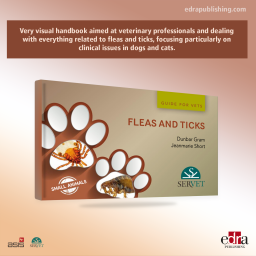
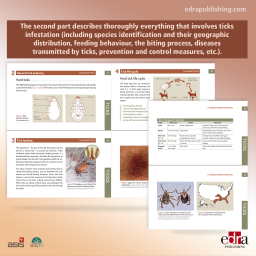
Very visual handbook aimed at veterinary professionals and dealing with everything related to fleas and ticks, focusing particularly on clinical issues in dogs and cats. The first part is entirely dedicated to fleas (including their identification, life cycle, clinical signs derived from flea infestation, flea allergy dermatitis (FAD), and prevention and control measures, among others). The second part describes thoroughly everything that involves ticks infestation (including species identification and their geographic distribution, feeding behaviour, the biting process, diseases transmitted by ticks, prevention and control measures, etc.).
This new atlas focuses on how parasitic diseases can be diagnosed, treated, and prevented, with a special emphasis on those aspects on which pet owners can have an influence. It includes a classification of parasitic diseases according to the organ systems they affect, parasites in exotic animals, and a description of the most important zoonoses transmitted by dogs and cats.
This new volume of the collection Pet Owner Educational Atlas aims to help pet owners gain a better understanding of parasites, always through their veterinary surgeon's explanations and recommendations. It continues with the goal established in the first work: helping veterinarians in their communication with the pet owners when it comes to explaining how a parasitic disease is affecting their pets.
This atlas addresses the immune mechanisms of dogs and cats and describes the most important infectious and parasitic diseases. It has been designed as an aid to veterinary surgeons to help owners understand the processes underlying the development of some of the most important diseases of their pets, the immune mechanisms involved, and the importance of disease prevention through immunisation. The digital version includes 3D animations.
Using a simple and graphical approach this atlas addresses the mechanisms involved in the immune responses of dogs and cats, and describes the most important infectious and parasitic diseases, as well as the corresponding preventive strategies.
This new volume of the Pet owner educational atlas collection on the cardiorespiratory system of dogs and cats pursues the same objective as the previous books: helping veterinary surgeons to communicate with pet owners. In addition, as its contents are focused on one single system, the specificity of the topics addressed will also help veterinary practitioners to consolidate and broaden their knowledge.
This illustrated work aims at helping veterinary surgeons to communicate with pet owners. After the previous volume about surgery, this atlas dedicated to dermatology helps the vet to explain the physiological and pathological characteristics of skin as well as the characteristics of diagnostic tests, treatments and surgical techniques. Every illustration describes the clinical aspects of the dermatology consultation: anatomical and physiological considerations about the skin and its adnexa, and graphic descriptions of infectious, inflammatory, endocrine, allergic or tumoral diseases. The clarity and accuracy of the illustrations turn this atlas into another useful clinical tool.
Handbook entirely dedicated to avian infectious laryngotracheitis (ILT), based on a handy and visual approach of the topic. This handbook has been developed by prestigious, highly experienced, and renowned authors, being experts in the area of avian diseases. An up-to-date and complete review has been carried out including the most significant contents, such as etiology, epidemiology, pathogenesis, clinical manifestations, etc. A chapter about vaccination has been properly developed in order to provide the main guidelines to avoid vaccination failures and control its prevalence and incidence.
The number of new technology vaccines available has been increased worldwide, as well as their widespread use in the poultry industry, especially at hatchery level. Therefore, an updated review with practical and visual approach has been developed in order to highlight the importance of hatchery vaccination in poultry farming, whatever the vaccination technique used (in ovo, subcutaneous or spray vaccination), to control the main diseases affecting this species (infectious bursal disease, Newcastle disease, infectious laryngotracheitis, etc.). This handbook has been written by an expert with wide experience in this field. Numerous graphic resources have been included to complement the information provided and make the contents more understandable and accessible to readers.
The most updated information on avian influenza with a practical approach. The authors review the aetiology, clinical signs, diagnosis, and control of avian influenza viruses. It also includes numerous graphic resources to make the contents more understandable to readers.
A vaccination failure occurs when the chickens do not develop suitable antibody titer levels and/or are susceptible to a field disease outbreak. Therefore, an updated review has been thoroughly developed in order to highlight the importance of detecting and solving the major vaccination failures in commercial chickens.
Infectious bronchitis is an acute and highly contagious respiratory disease of chickens characterized by respiratory signs comprising gasping, coughing, sneezing, tracheal rales and nasal discharge. In addition, severe respiratory distress may occur in young chickens. Respiratory distress, decrease in egg production, and loss of internal egg quality and eggshell quality have been reported in layers. Some strains of the virus produce severe kidney damage and may be associated with high mortality.
In this comprehensive review of infectious bursal disease, the author uses graphic resources accompanied by short texts to describe the disease in an accessible manner. The information provided in this handbook will allow professionals to deal with this disease more effectively.
Atlas entirely dedicated to infectious bursal disease based on a practical and graphic approach of the topic. This handbook has been carried out by highly experienced authors closely involved with this disease in Africa, where its prevalence and incidence are significant. This updated work has been carefully developed including the most essential contents, so that it depicts a valuable tool to cope and control this virus as far as possible. Includes many helpful tips and visual graphic resources provided by the authors to enrich and turn this atlas into a reference in its field. Furthermore, diagnosis and vaccination have been thoroughly explained, highlighting vaccination programmes and types of vaccines. The atlas format helps to make the contents understandable for readers.
Updated review of Newcastle disease presented in a visual and practical manner. The chapter dedicated to the clinical diagnosis of the disease will surely be of great interest to the reader. The vaccination section provides the main guidelines to prevent vaccine failures and control the immunological status of the operation.
A visual atlas which describes –day by day– the hole process of embryonic development in order to be able to identify critical points in this process so a final and correct diagnosis can be established.
Vaccination is one of the cornerstones of poultry production. In fact, it is one of the aspects that most influence production parameters in the poultry industry. In broilers, the optimum time of vaccination should aim at obtaining the maximum meat yield. In layers and breeders, both time and the route of administration have an influence in the quality of egg shells and the number of eggs per laying, among others.
The goal of this work is to present the reader with the most common diseases that can produce immunosuppression in poultry, provide guidance for the diagnosis of immunosuppressive diseases, and examine the challenges that a diagnostician may face in confirming a diagnosis of immunosuppression. The book will feature an extensive collection of color photographs depicting gross and microscopic images.