
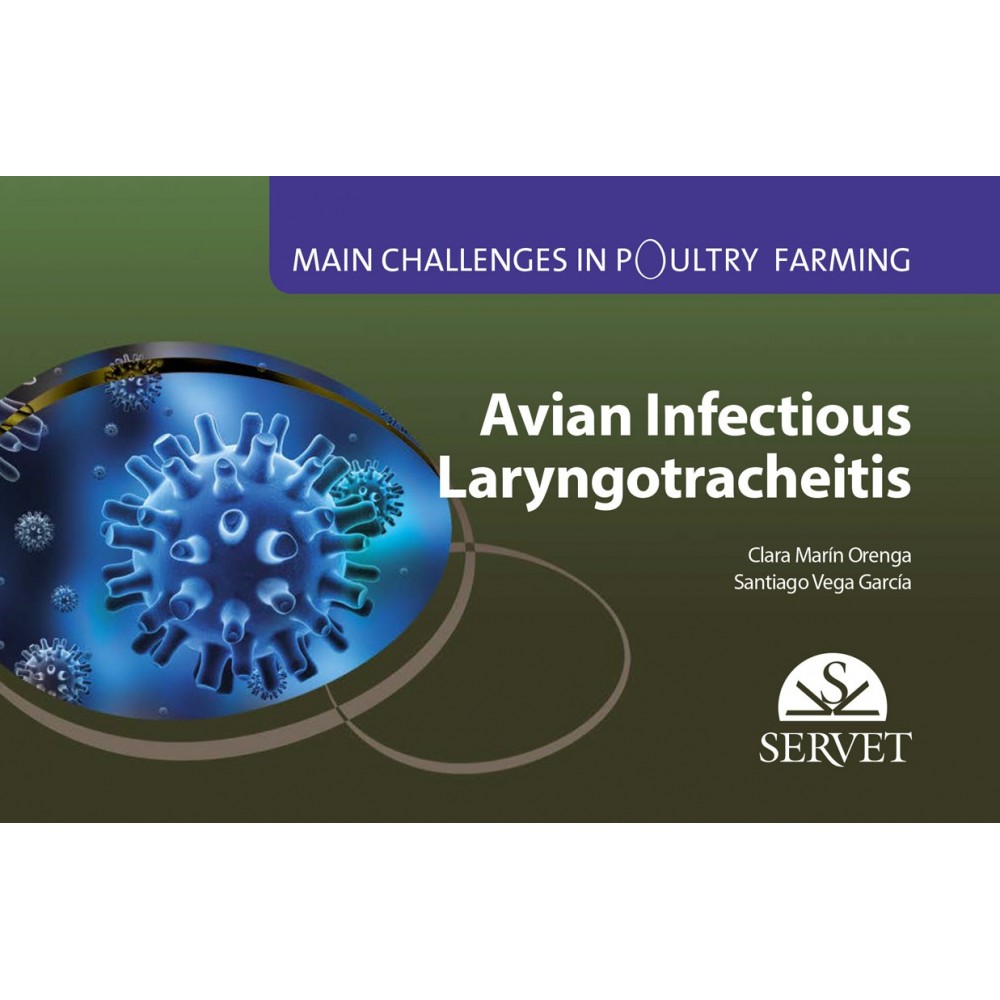


Handbook entirely dedicated to avian infectious laryngotracheitis (ILT), based on a handy and visual approach of the topic. This handbook has been developed by prestigious, highly experienced, and renowned authors, being experts in the area of avian diseases. An up-to-date and complete review has been carried out including the most significant contents, such as etiology, epidemiology, pathogenesis, clinical manifestations, etc. A chapter about vaccination has been properly developed in order to provide the main guidelines to avoid vaccination failures and control its prevalence and incidence.
Handbook entirely dedicated to avian infectious laryngotracheitis (ILT), based on a handy and visual approach of the topic. This handbook has been developed by prestigious, highly experienced, and renowned authors, being experts in the area of avian diseases. An up-to-date and complete review has been carried out including the most significant contents, such as etiology, epidemiology, pathogenesis, clinical manifestations, etc. A chapter about vaccination has been properly developed in order to provide the main guidelines to avoid vaccination failures and control its prevalence and incidence.
Authors:
CLARA MARÍN ORENGA
Lecturer at the Veterinary Faculty of the University CEU Cardenal Herrera in Valencia (Spain). Named European diplomate for poultry by the European College of Poultry Science.
SANTIAGO VEGA GARCÍA
Dean of the Faculty of Veterinary Medicine of the University CEU Cardenal Herrera. Member of the European and National Conference of Deans of the different degrees of health sciences.
Key Features:
➜ Updated and graphic review about avian infectious laryngotracheitis (ILT).
➜ Written by renowned experts in this field.
➜ Visual, didactic, easy-to-handle format.
Table of Contents:
1. Introduction
General definition
Synonyms
Economic significance
History
2. Aetiology
The virus
Taxonomy
Morphology
3. Epidemiology
Hosts
Age distribution
Geographic distribution
Transmission
Incubation period
Incidence
Mortality
4. Pathogenesis
ILTV pathogenesis cycle
5. Clinical manifestations
6. Immunity
7. Diagnosis
Diagnosis
History and clinical signs
Gross post-mortem lesions
Histological changes
Immunological techniques
Antibody detection methods (serology)
Antigen detection methods
Virus isolation in cell cultures
Molecular techniques
8. Prevention and control
Control through vaccination
Available vaccines
Hatchery vaccination
Mechanism of protection
Vaccination failure
Management control
Biosecurity
Cleaning and disinfection
Genetic control
Data sheet
Specific References
Through 60 cases of questions and answers (Q&A), in which real situations in the veterinary profession are reflected, an entirely practical review of bovine endoparasites and ectoparasites is carried out. The book is divided into four chapters dedicated to endoparasites of the digestive and respiratory apparatus, systemic endoparasites and cutaneous parasites. It's more than 260 images and diagrams, give this work an atlas character of bovine parasitology.
Handy and rigorous book focused on the main bacterial infections in poultry farming. It combines relevant information when dealing with the diseases and scientific background information. Each chapter comprises the most updated information to better understand the various infections and numerous high-quality images have been included to complement the information provided.
This guide describes the main events that take place during the dry period, both in the udder and in the cow, and shows how they can influence the subsequent lactation period. The book also provides basic guidelines for a proper drying-off technique and management of cows during this period in order to reduce the prevalence of intramammary infections and achieve optimal milk production.
Atlas entirely dedicated to the most important parasites and parasitic diseases of sheep, and written by a prestigious specialist in Parasitology with a wide experience in this species. More than 300 high-quality images have been included to show, among other things, the main parasites (protozoa, helminths and arthropods) infecting sheep, providing identification features to clearly distinguish between species, as well as the principal clinical signs derived from each infection. Each chapter has been dedicated to a specific anatomic system of sheep.
Handbook entirely dedicated to avian infectious laryngotracheitis (ILT), based on a handy and visual approach of the topic. This handbook has been developed by prestigious, highly experienced, and renowned authors, being experts in the area of avian diseases. An up-to-date and complete review has been carried out including the most significant contents, such as etiology, epidemiology, pathogenesis, clinical manifestations, etc. A chapter about vaccination has been properly developed in order to provide the main guidelines to avoid vaccination failures and control its prevalence and incidence.


