
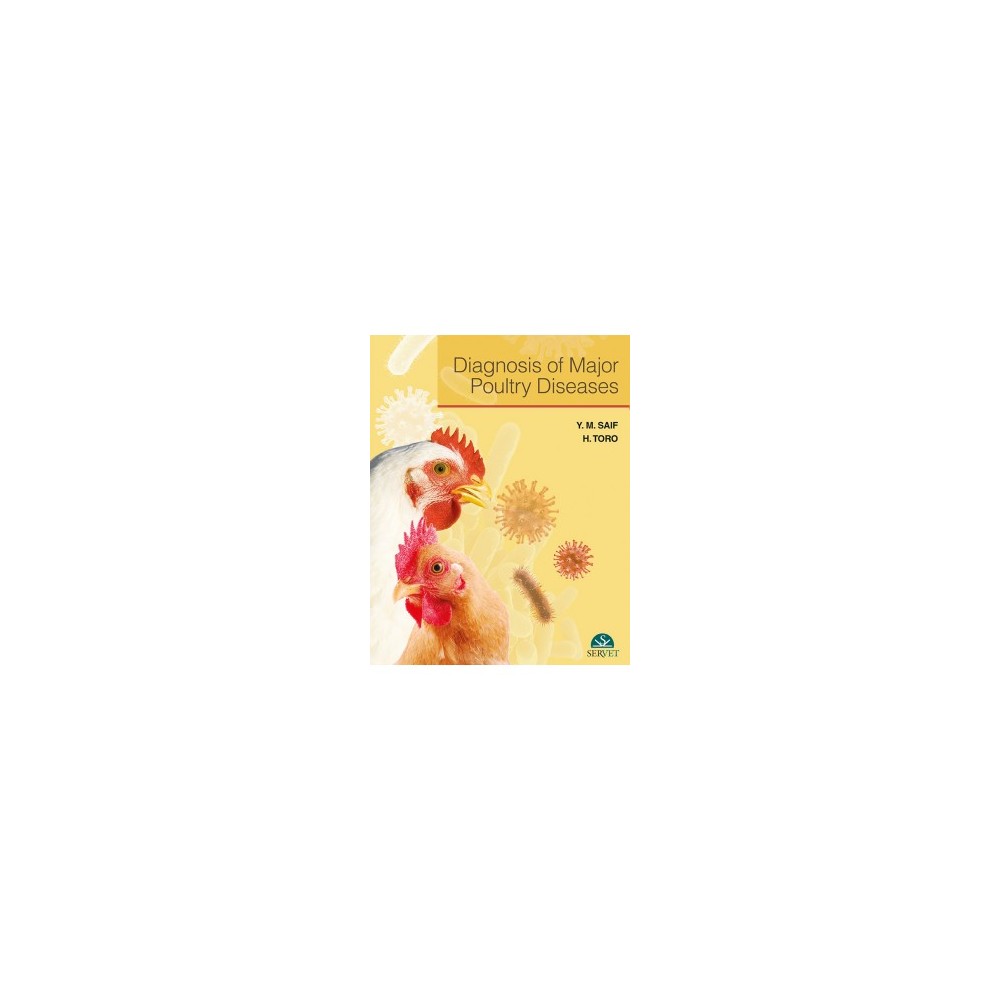


Handy and rigorous book focused on the diagnosis of the main diseases affecting poultry through a practical and visual approach of the topic, and written by prestigious experts with a wide experience in this field. Each disease has been thoroughly reviewed including the most updated information (clinical signs, gross and microscopic pathology, as well as methods of isolation or detection of the etiologic agent(s) and serologic methods for antibody detection) to better understand the content. Numerous graphic resources (images, graphs, tables, flowcharts) have been included to complement the information provided and make the contents understandable and accessible to readers.
Handy and rigorous book focused on the diagnosis of the main diseases affecting poultry through a practical and visual approach of the topic, and written by prestigious experts with a wide experience in this field. Each disease has been thoroughly reviewed including the most updated information (clinical signs, gross and microscopic pathology, as well as methods of isolation or detection of the etiologic agent(s) and serologic methods for antibody detection) to better understand the content. Numerous graphic resources (images, graphs, tables, flowcharts) have been included to complement the information provided and make the contents understandable and accessible to readers.
Authors:
YEHIA “MO” SAIF
Professor and Head Emeritus of the Food Animal Health Research Program of the Ohio Agricultural Research and Development Center (OARDC) at The Ohio State University (OSU).
HAROLDO TORO
Professor in the Department of Pathobiology at Auburn University.
KEY FEATURES:
➜ Practical and visual approach of the topic.
➜ Written by prestigious experts.
➜ Useful tool for the practicing veterinarian and the laboratory diagnostician.
Table of Contents:
1. Principles of diagnosis in
poultry
(M. J. Pantin-Jackwood)
2. Viral diseases
Newcastle disease and other
paramyxovirus infections
(E. Spackman)
Infectious bronchitis
(V. L. van Santen and H. Toro)
Infectious laryngotracheitis
(G. Beltrán and M. García)
Avian influenza
(L. Wang and Y. Zhang)
Infectious bursal disease
(Y. M. Saif)
Marek’s disease
(J. Dunn)
Avian leukosis
(G. Zavala)
Chicken infectious anemia
(H. Toro)
Reovirus infections
(E. Spackman)
Metapneumovirus infections
(Q. Yu)
Fowlpox
(D. N. Tripathy)
Adenoviral diseases
(F. W. Pierson)
Enteric viral infections
(Y. M. Saif)
Avian encephalomyelitis
(H. L. Shivaprasad)
3. Bacterial diseases
Salmonellosis
(R. Gast and W. D. Waltman)
Fowl cholera
(M. Prarat and J. Cui)
Mycoplasma infections
(M. El-Gazzar)
Infectious coryza
(C. L. Hofacre, M. Lee, J. R. Glisson and G.
Zavala)
Bordetellosis
(K. B. Register)
Ornithobacterial infections
(H. M. Hafez)
Clostridial diseases
(K. V. Nagaraja and A. Thachil)
Campylobacteriosis
(I. Kassem and G. Rajashekara)
4. Fungal diseases
Aspergillosis
(M. França and H. L. Shivaprasad)
5. Protozoal diseases
Coccidiosis
(R. Hauck)
Histomoniasis
(R. Hauck)
Data sheet
Specific References
The most updated information on avian influenza with a practical approach. The authors review the aetiology, clinical signs, diagnosis, and control of avian influenza viruses. It also includes numerous graphic resources to make the contents more understandable to readers.
This handbook complements the former book by the same author, Swine disorders guide, published by Servet in 2014. This new guide is focused on the diagnosis of swine disorders, including clinical examination and clinical signs, and includes a deep review of the main disorders according to their clinical signs.
Artificial insemination (AI) is an indispensable technique on swine farms, and its success depends primarily on semen quality. This handbook covers the key steps necessary to obtain high-quality processed semen and ensure successful AI. Essential practical considerations are clearly detailed in each chapter.
This book serves as a useful tool for learning about the most common diseases of tilapia (both red and Nile) raised in intensive and semi-intensive systems. It covers both macroscopic and microscopic lesions as well as elements of production and parameters of water quality which are critical to determining the health and disease of these fish.
Handy and rigorous book focused on the diagnosis of the main diseases affecting poultry through a practical and visual approach of the topic, and written by prestigious experts with a wide experience in this field. Each disease has been thoroughly reviewed including the most updated information (clinical signs, gross and microscopic pathology, as well as methods of isolation or detection of the etiologic agent(s) and serologic methods for antibody detection) to better understand the content. Numerous graphic resources (images, graphs, tables, flowcharts) have been included to complement the information provided and make the contents understandable and accessible to readers.


