
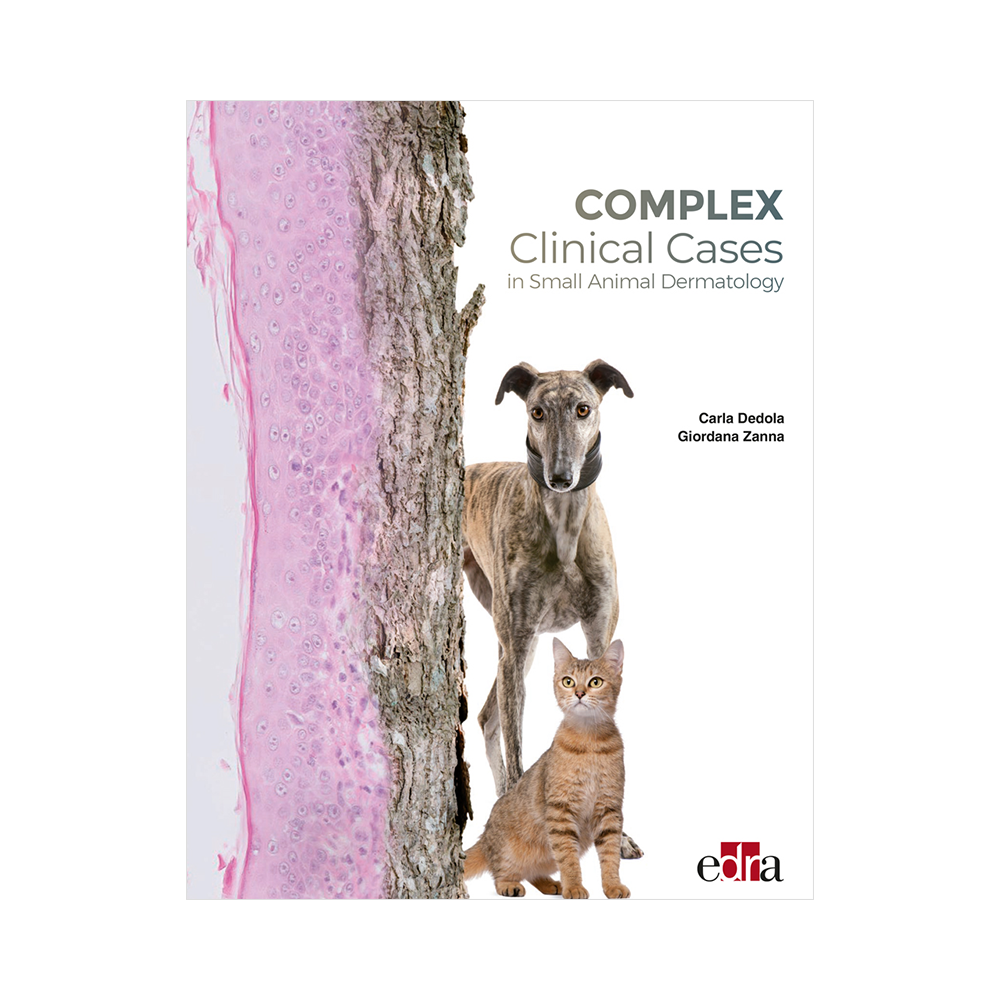

This book has been created for everyone passionate about veterinary dermatology. Written by veterinary experts, this resource will explore the diagnostic thinking process. This practical book describes complex dermatological clinical cases through the evaluation of their clinical presentation, results of diagnostic procedures and treatment strategies. Fully illustrated with colour pictures, it also includes tables and clinical keys.
This book has been created for everyone passionate about veterinary dermatology. Written by veterinary experts, this resource will explore the diagnostic thinking process. This practical book describes complex dermatological clinical cases through the evaluation of their clinical presentation, results of diagnostic procedures and treatment strategies. Fully illustrated with colour pictures, it also includes tables and clinical keys.
Carla Dedola
Dr. Carla Dedola graduated in Veterinary Medicine from the University of Sassari (Italy) in 2001. After completing her degree, she worked as a general practitioner in a private veterinary clinic in Monza (Italy). There, she started to develop her passion in small animal dermatology. In 2007, she obtained a position as resident in dermatology at the Royal (Dick) School of Veterinary Studies at the University of Edinburgh (Scotland). In 2010, she sustained and passed the European College exam in Veterinary Dermatology becoming a European Diplomate in Veterinary Dermatology. She has been secretary of the Italian Society of Small Animal Dermatology (SIDEV) in Italy from 2014 to 2019. Since 2011, she has been working as freelance in Sardinia (Italy), collaborating with numerous veterinary clinics over the territory. She is the director and the scientific mentor of dermatological courses organized by the Italian Companion Animal Veterinary Association (SCIVAC).
Giordana Zanna
Dr. Giordana Zanna graduated in Veterinary Medicine from the University of Bari (Italy) in 2000. After working in general practice in Italy and doing externships at Universities of Liverpool and Bristol (UK), she undertook a residency in veterinary dermatology at Universitat Autònoma de Barcelona (UAB) in Spain, gaining her diploma of the European College of Veterinary Dermatology in 2010. At the same Institution, she fulfilled her PhD studies on the pathogenesis of mucinosis-hyaluronosis in Shar Pei dogs in 2010. Vice president of the Italian SIDEV and secretary of the SCIVAC, she is the director and scientific mentor of the Italian course of Dermatology. Giordana now works at Instituto Veterinario di Novara (Italy) as a private practice dermatology specialist, and she regularly provides lectures in national courses both in Italy and Spain and gives talks at international conferences. She has written several articles published in national and international journals and she also enjoys research with a special interest in non-invasive diagnostic techniques such as dermoscopy.
Case 1. Generalized partial alopecia with scaling in a dog
Case 2. Alopecic, ulcerative and erythematous plaque on the tarsal region in a cat
Case 3. Severe ulcerative dermatitis in a dog
Case 4. Erosive and scaling dermatoses in a cat
Case 5. Muco-cutaneous ulcerative dermatitis in a dog
Case 6. Ulcerative multifocal dermatitis in a dog
Case 7. Generalized pustular dermatitis in a dog
Case 8. Nodular dermatitis in a dog
Case 9. Generalized alopecia in a cat
Case 10. Proliferative plaque-like lesions in a dog
Case 11. Generalized scaling dermatoses in a dog
Case 12. Multifocal alopecia in a dog
Case 13. Non-inflammatory alopecia affecting only the black-haired coat in two dogs
Case 14. Exfoliative dermatitis in a cat
Case 15. Nodular dermatitis in a dog
Case 16. Multifocal, polycyclic erythematous lesions with epidermal collarette in a dog
Case 17. Erosive-ulcerative dermatitis in a seasonal atopic dog
Case 18. Mucocutaneous ulcerative lesions of the nasal planum in a dog
Case 19. Severe necrotizing dermatitis on a dog’s leg
Case 20. Ulcerative dermatitis in a cat
Fiche technique
Références spécifiques
This atlas compiles clinical cases and images of pathological conditions. It will be very helpful for any vet needing to recognise macroscopical and microscopical lesions in sheep.
Due to the introduction of ultrasound, the acquisition of new anatomy and sonoanatomy knowledge, as well as recent discoveries on the role of the fascia, regional anesthesia has undergone a process of "evolution-revolution" in the last decade and now is playing a key-role in surgery and postoperative pain management, allowing opioid-sparing or opioid-free strategies, in line with the ERAS pathway.
Periodontology is the core of dentistry. Maintaining and restoring the health of tooth supporting tissues is the best way to ensure both their esthetic and functional integrity. This book systematically collects the most up-to-date knowledge on periodontal surgery.
The centrality of nutrition in the state of health of pets has emerged only in the recent years, both to prolong their life expectancy and to prevent the onset of serious diseases such as obesity, diabetes mellitus or liver lipidosis. The goal of this book is that each veterinarian can clearly answer the questions that are most frequently asked by the owners: Which type of food to choose? How to navigate between the different products on the market? The text also provides real recipes to be proposed in synergy with the nutritional handbooks of various food manufacturers, to consciously choose and be able to compare the nutritional characteristics of different products on the market.
This comprehensive guide, born from a profound understanding of the challenges faced by veterinarians, provides an authoritative and readily accessible resource for addressing urgent surgical needs in small animals. Dogs and cats often find themselves in critical situations necessitating swift and precise surgical intervention. Whether it's trauma-related injuries, acute abdominal crises, or unforeseen complications, the ability to navigate these emergencies with expertise is paramount.
This book has been created for everyone passionate about veterinary dermatology. Written by veterinary experts, this resource will explore the diagnostic thinking process. This practical book describes complex dermatological clinical cases through the evaluation of their clinical presentation, results of diagnostic procedures and treatment strategies. Fully illustrated with colour pictures, it also includes tables and clinical keys.


