
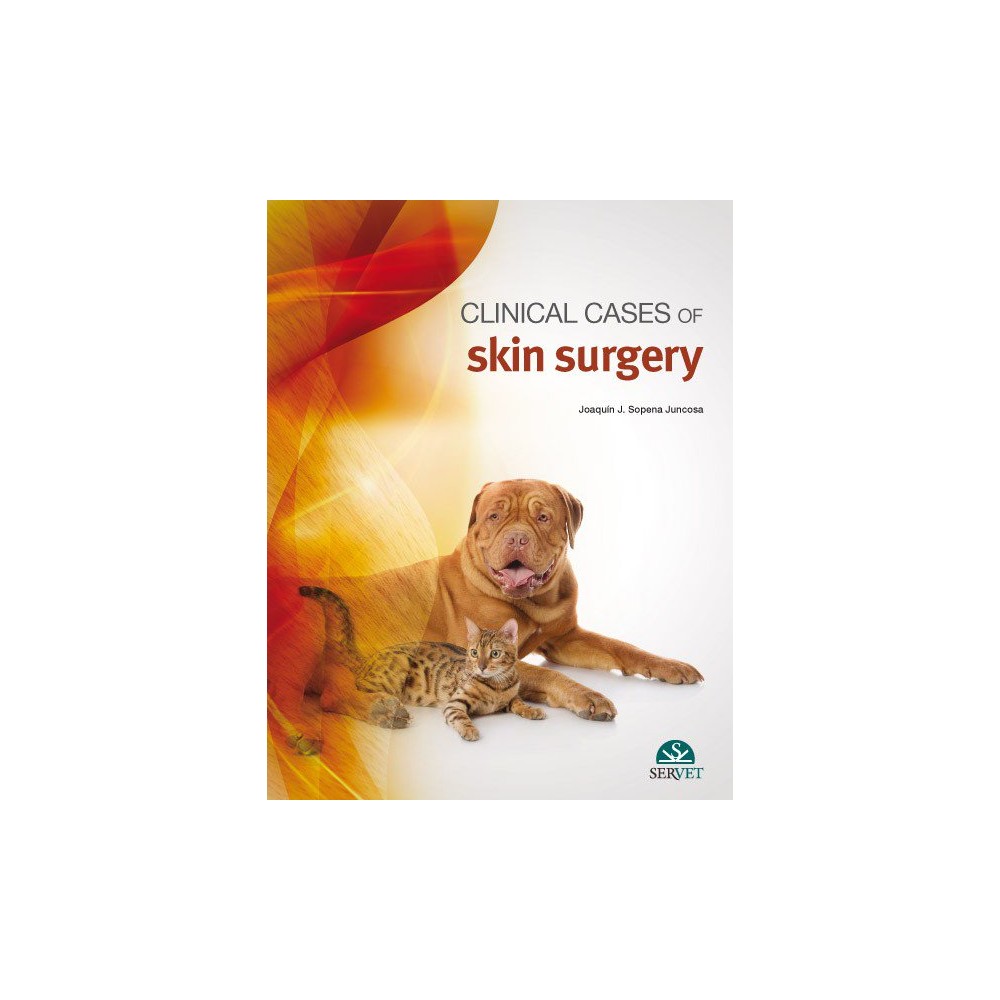


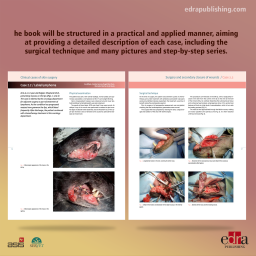
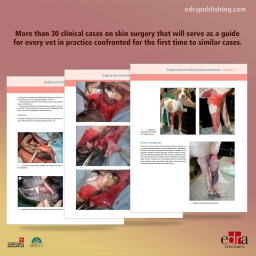
Dr. Joaquín J. Sopena has gathered together for that work a remarkable team of national and international specialists in skin surgery in small animals, presenting a versatile work on clinical cases. The book will be structured in a practical and applied manner, aiming at providing a detailed description of each case, including the surgical technique and many pictures and step-by-step series. More than 30 clinical cases on skin surgery will serve as a guide for every vet in practice confronted for the first time to similar cases. This publication will be a reference guide for those veterinary surgeons whose intention is to improve clinical management of big wounds requiring one or several surgeries.
Dr. Joaquín J. Sopena has gathered together for that work a remarkable team of national and international specialists in skin surgery in small animals, presenting a versatile work on clinical cases. The book will be structured in a practical and applied manner, aiming at providing a detailed description of each case, including the surgical technique and many pictures and step-by-step series. More than 30 clinical cases on skin surgery that will serve as a guide for every vet in practice confronted for the first time to similar cases. This publication will be a reference guide for those veterinary surgeons whose intention is to improve clinical management of big wounds requiring one or several surgeries.
The Author:
Joaquin Sopena
Graduate and Doctor of Medicine from the University of Zaragoza. Assistant Professor of the Dept. of Animal Medicine and Surgery at CEU Cardenal Herrera University (UCH CEU). Vice-Deacon of The Faculty of Veterinary Science at UCH CEU.
His research lines have focused on surgical techniques and advanced applied therapies in veterinary medicine and experimental surgery. He currently manages the Research Group for Experimental and Applied Veterinary Surgery at UCH CEU. In this field, he also works with the García Cugat Foundation for biomedical research. He has supervised 7 doctorate theses and has written over 50 scientific articles in national and international journals.
He is a member of the managing committee for the García Cugat Foundation-UCH CEU, the European Society of Veterinary Trauma and Orthopaedics (ES VOT), and the Spanish Association Small Animal Veterinary Surgeons (AVEPA).
Author of the book Wound management and principles of plastic surgery in small animals (Editorial Servet, 2009) and numerous papers and courses on plastic surgery and the management of large wounds at the national and international levels.
Table of contents:
1. Medical wound management
Introduction and techniques
Clinical cases
Case 1.1 / Postoperative wound dehiscence
Case 1.2 / Skin tear in the right chest wall
Case 1.3 / Wound in the forearm with conservative management
Case 1.4 / Deep tear in the neck
2. Surgery and secondary closure of wounds
Introduction and techniques
Mandibular degloving injuries
Case 2.1 / Complete mandibular degloving injury
Resection of lip tumors
Case 2.2 / Labial lymphoma
Case 2.3 / Labial plasmacytoma
Wounds caused by drug reactions
Case 2.4 / Cutaneous abrasion on forelimbs due to possible reaction to drugs
Wounds from vehicle impact with substance loss, tear wounds, and other complications.
Case 2.5 / Severe injury with substance loss on the right hind paw
Case 2.6 / Infected wound on the left hind limb
Case 2.7 / Tear wound in the perianal and perineal region in a female cat
Case 2.8 / Tear wound in the perianal and perineal region in a male cat
Case 2.9 / Decision on the management of a chronic cervical wound
Case 2.10 / Perianal tear wound
Case 2.11 / Complicated hind paw wound
3. Skin flaps
Introduction and techniques
Clinical cases
Case 3.1 / Correction of a skin defect in the right forelimb using a bipedicle flap
Case 3.2 / Plastic surgery in the area of the elbow after a tumor exeresis
Case 3.3 / Resolution of an avulsion injury in the limb using a single pedicle advancement flap
Case 3.4 / Tumour exeresis in the distal region of the forearm
Case 3.5 / H-plasty to correct a wound in the right iliac region
Case 3.6 / Chronic wound caused by a bite in the back
Case 3.7 / Wound caused by an iatrogenic burn
4. Skin grafts
Introduction and techniques
Clinical cases
Case 4.1 / Skin graft in the region of the forearm
Case 4.2 / Hit-by-car wound caused complicated by a fracture of the distal physis and malleolus of the tibia
Case 4.3 / Wound caused by extravasation of intravenous fluids
Case 4.4 / Infected wound in the distal region of the tibia
5. Complex techniques and regenerative techniques
Introduction and techniques
Clinical cases
Case 5.1 / Treatment of wounds using a mesh with growth factors
Case 5.2 / Single-pedicle, axial-pattern tubed flap after the exeresis of a perianal tumor
Case 5.3 / Combination of an axial pattern flap and skin expander in a chest wall wound
Case 5.4 / Chronic wound proximal to the elbow
Case 5.5 / Wound in the cervical region with a muscle tear
Case 5.6 / Plastic surgery in a case of malformation of the upper lip
Case 5.7 / Episioplasty
6. References
Fiche technique
Références spécifiques
Routine preventative dental care is essential to prevent dental and oral health problems in cats. With more than 400 high-quality images, clear anatomical illustrations, and thorough descriptions, this new volume on veterinary dentistry focused exclusively in cats aims at being a guide for quick visual identification and prompt diagnosis and treatment of oral and dental problems in this domestic species.
Dental care is essential to prevent dental and oral health problems in dogs. It is nowadays a routine procedure for most veterinary practices. However, some dental pathologies are sometimes really difficult to diagnose and treat. With almost 400 high-quality images, clear anatomical illustrations, and descriptions of numerous diagnostic tests, this atlas constitutes a reference handbook for a quick visual identification with a clear orientation towards a precise diagnosis and treatment. In short, this is an essential tool for a better understanding of dental pathologies in dogs.
Written by one of the most eminent specialists in Spain, this book enables veterinary surgeons to further their knowledge in physiotherapy and veterinary rehabilitation, as well as to discover the possibilities offered by this discipline in the treatment of musculoskeletal and nervous pathologies in pets.
The second edition of this book presents veterinary professionals with practical solutions to specific situations they may encounter due to new tendencies influencing the sector. The author gives clear, straightforward, and yet dynamic explanations of topics such as market research, how to form a team and retain staff, business plans and protocols, or how to control expenditure. The book has also been updated with the know-how required to get the most out of the new technologies and digital tools now available to veterinary practices (social media, digital marketing, etc.). The book aims to introduce veterinary professionals who own a practice to the management skills that can empower them to become cutting-edge veterinary entrepreneurs.
Dr. Joaquín J. Sopena has gathered together for that work a remarkable team of national and international specialists in skin surgery in small animals, presenting a versatile work on clinical cases. The book will be structured in a practical and applied manner, aiming at providing a detailed description of each case, including the surgical technique and many pictures and step-by-step series. More than 30 clinical cases on skin surgery will serve as a guide for every vet in practice confronted for the first time to similar cases. This publication will be a reference guide for those veterinary surgeons whose intention is to improve clinical management of big wounds requiring one or several surgeries.


