
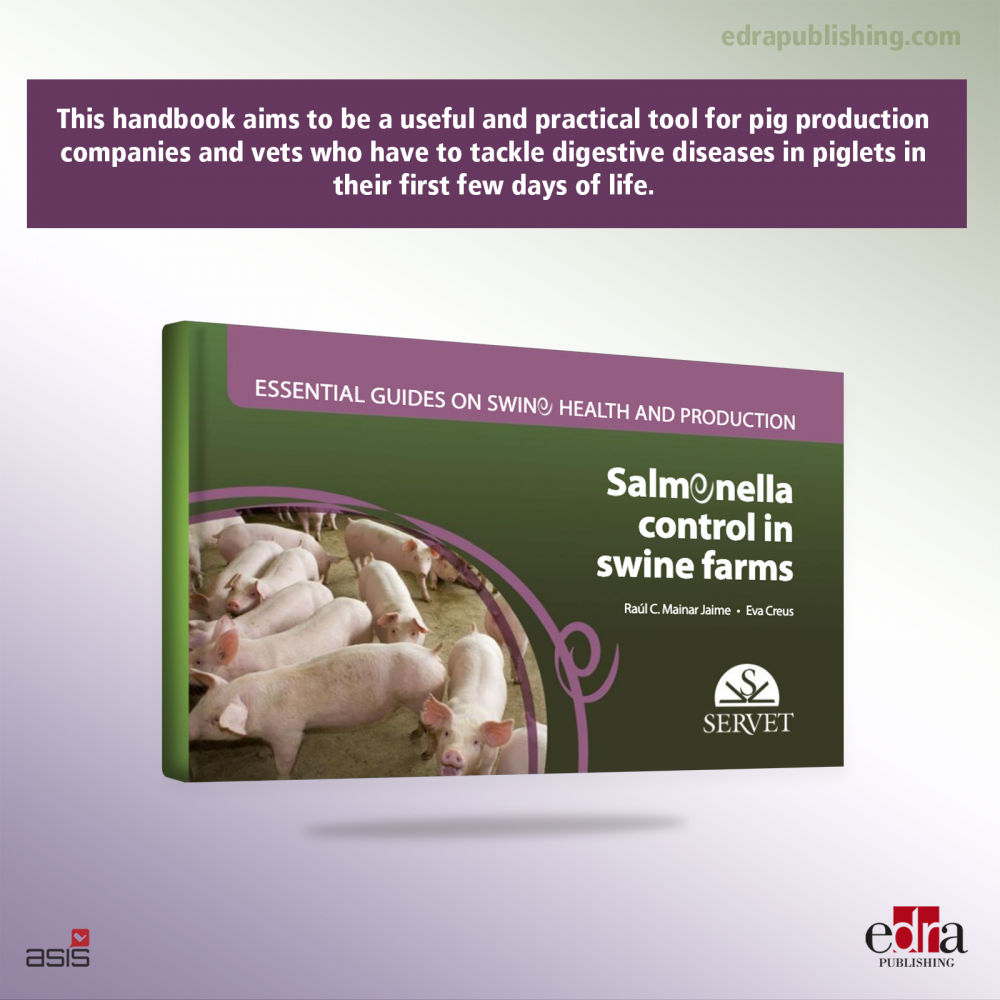


This practical book thoroughly reviews the current knowledge on salmonellosis in swine, and discusses the difficulty to control Salmonella spp. from a global perspective. It provides information about the actions that can be taken in order to reduce its incidence, with an emphasis on risk factors from feed manufacturing to carcass processing.
This practical book thoroughly reviews the current knowledge on salmonellosis in swine, and discusses the difficulty to control Salmonella spp. from a global perspective. It provides information about the actions that can be taken in order to reduce its incidence, with an emphasis on risk factors from feed manufacturing to carcass processing.
Authors:
RAÚL C. MAINAR JAIME
PhD in veterinary medicine from the Complutense University of Madrid, Spain. He currently teaches microbiology and immunology at the Faculty of Veterinary Medicine of the University of Zaragoza, Spain.
EVA CREUS
PhD in veterinary medicine from the Autonomous University of Zaragoza. She has actively collaborated with various universities and research centers on research projects related to the study of feeding strategies to control this salmonellosis in swine.
Key Features:
KEY FEATURES:
➜ Includes a review of the characteristics of Salmonella spp. infections and how they are
diagnosed.
➜ Provides useful guidelines to control salmonellosis both on pig farms and at the
slaughterhouse.
➜ Contains many pictures, diagrams and tables for a better understanding of the content.
Table of Contents:
1. The infection process
Characteristics of the genus Salmonella
Classification
Characteristics of Salmonella spp. infection in pig
Transmission
Pathogenesis
Clinical signs and lesions
2. Diagnostic methods
Bacterial culture
Serology
Other diagnostic techniques
Molecular methods: PCR
Sandwich ELISA
Conclusion
3. The role of nutrition
Feed hygiene: importance, risk factors, and
control measures
Feeding strategies to control Salmonella
infection
Feeding strategies and products used to control
salmonellosis
Final thoughts on these strategies
4. Epidemiology and control on the farm
Epidemiology and risk factors
Factors associated with Salmonella introduction
Factors associated with Salmonella persistence
Dynamics and transmission
Sows
Pre-weaners
Nursery
Fatteners
Replacement stock
Control measures
Biosecurity and management
Preventing infection
5. Post-farm considerations
The importance of transport to the
slaughterhouse and lairage
Characteristics and risk factors for
contamination at the slaughterhouse
Risks associated with each slaughter stage
Activities in the dirty area
Activities in the clean area
Potential measures to control contamination
Transport and lairage pens
Slaughterhouse
6. Developmentof a control programme
Stages of a control programme on farm
Stage 1: Diagnose the situation
Stage 2: Implement the measures
Stage 3: Assessment
Another potential option to control Salmonella
Fiche technique
Références spécifiques
Updated review of Newcastle disease presented in a visual and practical manner. The chapter dedicated to the clinical diagnosis of the disease will surely be of great interest to the reader. The vaccination section provides the main guidelines to prevent vaccine failures and control the immunological status of the operation.
The spectacular increase that pig production has experienced in recent years has generated a significant demand for information on the management and operation of pig farms. This book aims to update knowledge and showcase the latest developments relating to the management of porcine farrowing units
Through 60 cases of questions and answers (Q&A), in which real situations in the veterinary profession are reflected, an entirely practical review of bovine endoparasites and ectoparasites is carried out. The book is divided into four chapters dedicated to endoparasites of the digestive and respiratory apparatus, systemic endoparasites and cutaneous parasites. It's more than 260 images and diagrams, give this work an atlas character of bovine parasitology.
The objective of this guide is to provide a practical summary regarding current knowledge and understanding of porcine reproductive and respiratory syndrome (PRRS). The information presented is focused on clinically relevant and practical information to help field veterinary surgeons and farm team personnel interested in animal health.
This practical book thoroughly reviews the current knowledge on salmonellosis in swine, and discusses the difficulty to control Salmonella spp. from a global perspective. It provides information about the actions that can be taken in order to reduce its incidence, with an emphasis on risk factors from feed manufacturing to carcass processing.


