
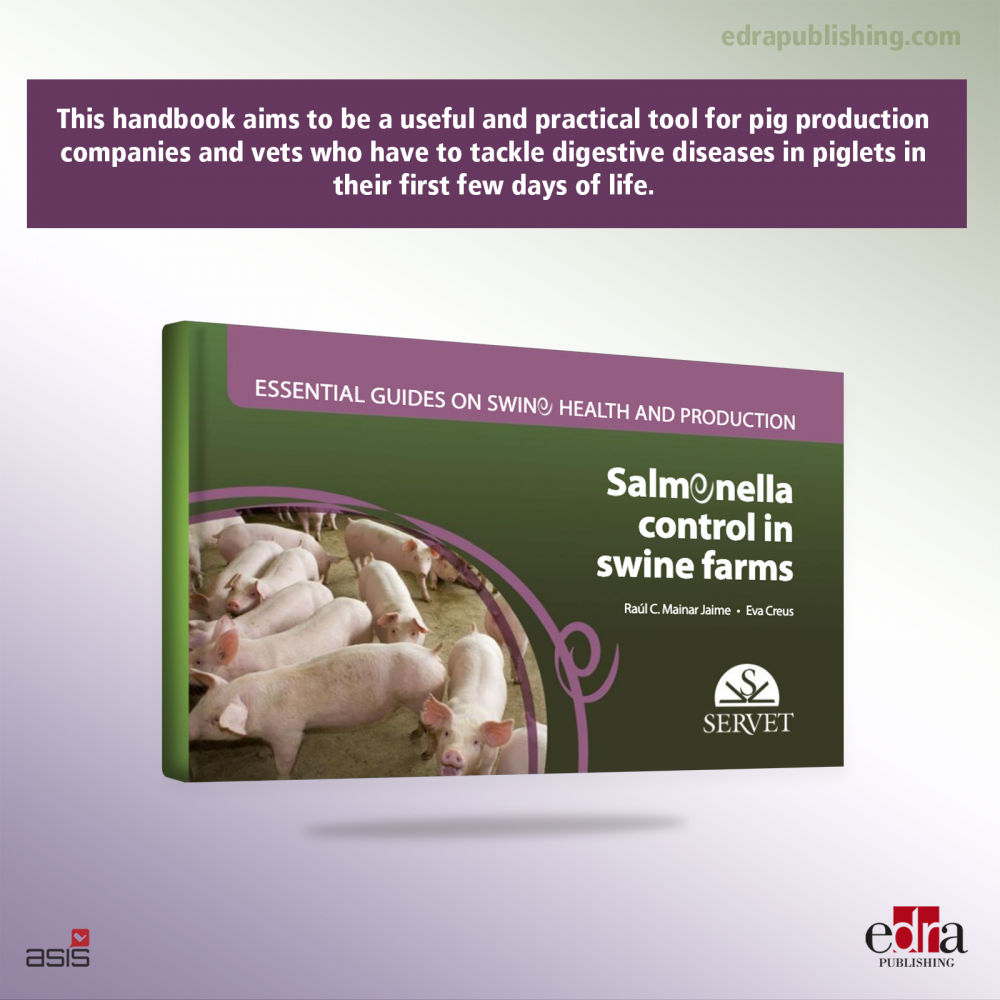


This practical book thoroughly reviews the current knowledge on salmonellosis in swine, and discusses the difficulty to control Salmonella spp. from a global perspective. It provides information about the actions that can be taken in order to reduce its incidence, with an emphasis on risk factors from feed manufacturing to carcass processing.
This practical book thoroughly reviews the current knowledge on salmonellosis in swine, and discusses the difficulty to control Salmonella spp. from a global perspective. It provides information about the actions that can be taken in order to reduce its incidence, with an emphasis on risk factors from feed manufacturing to carcass processing.
Authors:
RAÚL C. MAINAR JAIME
PhD in veterinary medicine from the Complutense University of Madrid, Spain. He currently teaches microbiology and immunology at the Faculty of Veterinary Medicine of the University of Zaragoza, Spain.
EVA CREUS
PhD in veterinary medicine from the Autonomous University of Zaragoza. She has actively collaborated with various universities and research centers on research projects related to the study of feeding strategies to control this salmonellosis in swine.
Key Features:
KEY FEATURES:
➜ Includes a review of the characteristics of Salmonella spp. infections and how they are
diagnosed.
➜ Provides useful guidelines to control salmonellosis both on pig farms and at the
slaughterhouse.
➜ Contains many pictures, diagrams and tables for a better understanding of the content.
Table of Contents:
1. The infection process
Characteristics of the genus Salmonella
Classification
Characteristics of Salmonella spp. infection in pig
Transmission
Pathogenesis
Clinical signs and lesions
2. Diagnostic methods
Bacterial culture
Serology
Other diagnostic techniques
Molecular methods: PCR
Sandwich ELISA
Conclusion
3. The role of nutrition
Feed hygiene: importance, risk factors, and
control measures
Feeding strategies to control Salmonella
infection
Feeding strategies and products used to control
salmonellosis
Final thoughts on these strategies
4. Epidemiology and control on the farm
Epidemiology and risk factors
Factors associated with Salmonella introduction
Factors associated with Salmonella persistence
Dynamics and transmission
Sows
Pre-weaners
Nursery
Fatteners
Replacement stock
Control measures
Biosecurity and management
Preventing infection
5. Post-farm considerations
The importance of transport to the
slaughterhouse and lairage
Characteristics and risk factors for
contamination at the slaughterhouse
Risks associated with each slaughter stage
Activities in the dirty area
Activities in the clean area
Potential measures to control contamination
Transport and lairage pens
Slaughterhouse
6. Developmentof a control programme
Stages of a control programme on farm
Stage 1: Diagnose the situation
Stage 2: Implement the measures
Stage 3: Assessment
Another potential option to control Salmonella
Data sheet
Specific References
The goal of this work is to present the reader with the most common diseases that can produce immunosuppression in poultry, provide guidance for the diagnosis of immunosuppressive diseases, and examine the challenges that a diagnostician may face in confirming a diagnosis of immunosuppression. The book will feature an extensive collection of color photographs depicting gross and microscopic images.
Technical book on avian inspection, written by an experienced author in this topic, which tackles the most important findings noticed during broiler meat inspection at abattoirs. After starting with an introduction about poultry inspection, the book describes the most significant conditions (pathologies, rejections due to poor processing, offal for human consumption) found during broiler inspection. Each chapter is divided in three parts clearly differentiated: definition, origin, and responsibilities arising for veterinarian/ inspector. A chapter entirely dedicated to animal welfare is included within this book. It is focused on the major aspects to be considered by veterinarian/inspector under compliance with current legislation.
This handbook is intended to be a useful and practical tool primarily developed for pig production companies, as well as for veterinary practitioners faced with enteric disease affecting piglets in their first days of life. The contents are the result of the joint efforts of highly-regarded specialists with years of experience in the field of enteric diseases in swine..
Atlas exclusively dedicated to the most important parasites and parasitoses of sheep. It is an eminently practical publication, with numerous images that help to identify parasites and understand their biological cycles. It includes a chapter on the key diagnostic techniques used to identify adult parasites, eggs and larvae.
This practical book thoroughly reviews the current knowledge on salmonellosis in swine, and discusses the difficulty to control Salmonella spp. from a global perspective. It provides information about the actions that can be taken in order to reduce its incidence, with an emphasis on risk factors from feed manufacturing to carcass processing.


