
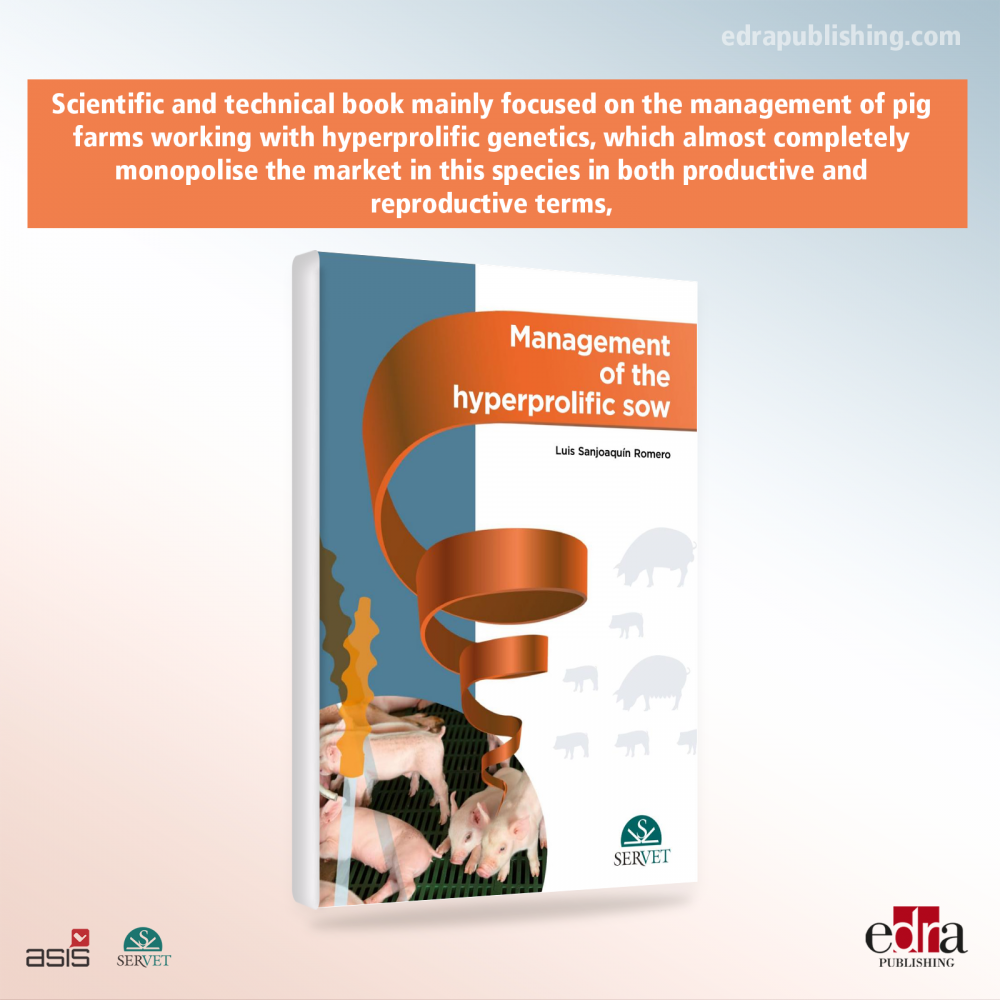


Technical work mainly focused on the management of pig farms working with hyperprolific genetics, which almost completely monopolize the market in this species in both productive and reproductive terms. The author, a renowned experienced specialist in swine genetics, provides key information to facilitate the management of these lines by veterinary professionals.
Technical work mainly focused on the management of pig farms working with hyperprolific genetics, which almost completely monopolize the market in this species in both productive and reproductive terms. The author, a renowned experienced specialist in swine genetics, provides key information to facilitate the management of these lines by veterinary professionals.
Author:
LUIS SANJOAQUÍN ROMERO
Graduated in Veterinary Science from the University of Zaragoza (Spain). Founder of the company SIGMAVET SLP, which offers advice to companies working in the swine industry.
Key Features:
➜ Practical approach to pig production.
➜ Written by a renowned expert in the field of hyperprofilic genetics.
➜ Key information to manage the hyperprofilic lines in pig farms.
Table of Contents:
1. Choosing a genetic line
2. Rearing
Feeding
Conditions during the breeding phase
Observation phase
Adaptation phase
3. Stimulation and detection of oestrus
Teaser boar
Signs of proestrus
Oestrus
4. Artificial insemination (AI)
Insemination regimen
Al techniques
Cervical AI
Postcervical AI
Feeding during the weaning-service interval
5. Gestation
Feeding management
Days 0–30 of gestation
Days 30–90 of gestation
Days 90–110 of gestation
Day 110 of gestation – farrowing
Measuring backfat
Facilities
Assessment of BC
Days 0–28 of gestation
Days 28–110 of gestation
Gestation failures
6. Maternity
Entry of sows into the farrowing unit
Scheduling of farrowing
Signs of farrowing
Farrowing
Stages of farrowing
Assistance at farrowing
Colostrum feeding
Cross-fostering
Special recommendations for small piglets
Nurse sows
Weekly batch farrowing
Two-weekly batch farrowing
Three-weekly batch farrowing
Four-weekly batch farrowing
Nurse sows for growth-retarded piglets
Lactation
Factors implicated in milk production
Feeding management
Peripartum
Recommendations for proper lactation
Sow feeding program
Feeding piglets
Facilities
Postpartum pathologies of the sow
7. Weaning
8. Water quality
9. Tables
Mycotoxins
Temperature
Light
Noise level
Air quality
Body temperature and respiratory rate
Animal density
10. Data analysis and objectives
11. References
Fiche technique
Références spécifiques
The spectacular increase that pig production has experienced in recent years has generated a significant demand for information on the management and operation of pig farms. This book aims to update knowledge and showcase the latest developments relating to the management of porcine farrowing units
In this book on practical antibiotherapy in swine medicine, the author has tried to present, in a visual and practical way and with an updated view, the most important aspects a veterinary clinician should take into account to design appropriate antimicrobial treatments in swine herds. Thus, in this work, current pharmacological knowledge is reviewed with the help of real clinical cases solved by the author. Finally, it includes a comprehensive review of what a prudent use of these essential tools to ensure our animals’ health means.
This guide is a visual and practical explanation of what should happen from the moment when you receive the semen from the artificial insemination centre, until the moment when the sow is inseminated, with a focus on the use of refrigerated semen: conservation and management of seminal doses, oestrus detection, identification of the best time for insemination, insemination methods, and hormonal control of oestrus and ovulation.
Handy and rigorous book focused on the diagnosis of the main diseases affecting poultry through a practical and visual approach of the topic, and written by prestigious experts with a wide experience in this field. Each disease has been thoroughly reviewed including the most updated information (clinical signs, gross and microscopic pathology, as well as methods of isolation or detection of the etiologic agent(s) and serologic methods for antibody detection) to better understand the content. Numerous graphic resources (images, graphs, tables, flowcharts) have been included to complement the information provided and make the contents understandable and accessible to readers.
Technical work mainly focused on the management of pig farms working with hyperprolific genetics, which almost completely monopolize the market in this species in both productive and reproductive terms. The author, a renowned experienced specialist in swine genetics, provides key information to facilitate the management of these lines by veterinary professionals.


